
How to Win Hesitant Clients by Building Trust and Confidence

Local business owners and small marketing teams often face the same customer conversion challenges: hesitant customers show interest, ask thoughtful questions, and then stall right at the decision. The instinct is to push harder, but pressure sales tactics usually raise the perceived risk and make higher-value clients protect their time and budget. When the message feels urgent, the choice feels dangerous, and “maybe later” becomes the safest option. The real advantage comes from creating confidence so decisions feel steady and straightforward.
Understanding the Trust Stack
Trust is rarely one thing. It is a stack of signals that tells a hesitant buyer your work is predictable, safe, and worth the cost. Social proof, clear communication, professionalism, and business credibility reduce perceived risk until the question shifts from “convince me” to “I feel safe choosing you.”
This matters because many prospects want results, but fear surprises. The trust gap shows why good intentions are not enough when buyers feel uncertain. When you lead with clarity and proof, decisions speed up without pressure.
Picture a business owner comparing two web partners. One offers a vague estimate and a few buzzwords, while the other shares reviews, a clear scope, and simple next steps. That second option feels safer because the honesty and transparency are easy to see.
With that foundation, the decision path becomes easier to map and reinforce with credibility signals and calm follow-through.
Build Confidence at Every Step: Online-to-In-Person Trust Playbook
Hesitant clients don’t need more pressure, they need fewer unknowns. Use these customer confidence strategies to guide their decision-making process with clear proof, predictable steps, and “you’re in good hands” credibility signals.
- Map the client journey from “curious” to “committed”: Write down the 5–7 steps a cautious buyer typically takes (search → compare → shortlist → ask questions → review proof → agree scope → pay). For each step, add one trust-building method that removes risk, like a one-page service overview at “compare” or a simple proposal template at “agree scope.” This turns your professionalism into a visible system, not a promise.
- Make your offer impossible to misunderstand: On your website, create one primary service page per offer with three things above the fold: who it’s for, what they get, and what happens next. Add a short “What this is / What this isn’t” box to prevent mismatched expectations. If you can share price ranges or starting packages, do it. Evidence from one case study suggests that showing pricing information can be a meaningful conversion lever because it reduces the fear of a surprise bill.
- Turn outcomes into documented proof (not hype): Build 3–5 mini case studies that follow a simple format: the problem, your process, the result, and one client quote. Use screenshots, before/after visuals, or a short metrics snapshot (even “reduced revisions from 6 rounds to 2” counts). Keep them scannable so a hesitant client can validate you in two minutes.
- Standardize your business identity everywhere clients might check: Ensure your name, service area, email, phone, and website match across your site, social profiles, listings, and invoices. Create a “business details” doc and update it quarterly so nothing drifts. Consistency is a quiet credibility signal, when everything aligns, clients stop wondering if you’re “real” and start focusing on fit.
- Strengthen business legitimacy with formal documentation (including incorporation): Add trust anchors that reassure risk-averse buyers: a written agreement, clear refund/cancellation terms, and an onboarding checklist. If you’re ready for the next step, forming a corporation or LLC can help you present as a stable, long-term partner; pair that with basics like a business bank account and professional invoices/receipts. Place these signals on your site’s footer or “About” page so clients see structure, not ambiguity.
- Reinforce online trust in person with calm, consistent follow-through: In meetings, restate the goal, recap what you heard, then offer two clear paths (for example: “Option A: quick win this week” vs. “Option B: full rebuild over four weeks”). End every call with a written recap and the next two steps, including dates. When you do what you said you’d do, every time, confidence becomes the default.
When you combine clarity, proof, professionalism, and legitimacy, you lower perceived risk at every decision point, making it easier to choose the trust signals that best match your business and your clients.
Trust-Building Tactics Compared
These options help you choose the right trust signals based on effort, likely impact, and fit for buyers who need clarity before committing. For business owners hiring creative and technical support, this framework makes it easier to prioritize what reduces risk fastest across your website, proposals, and client communication.
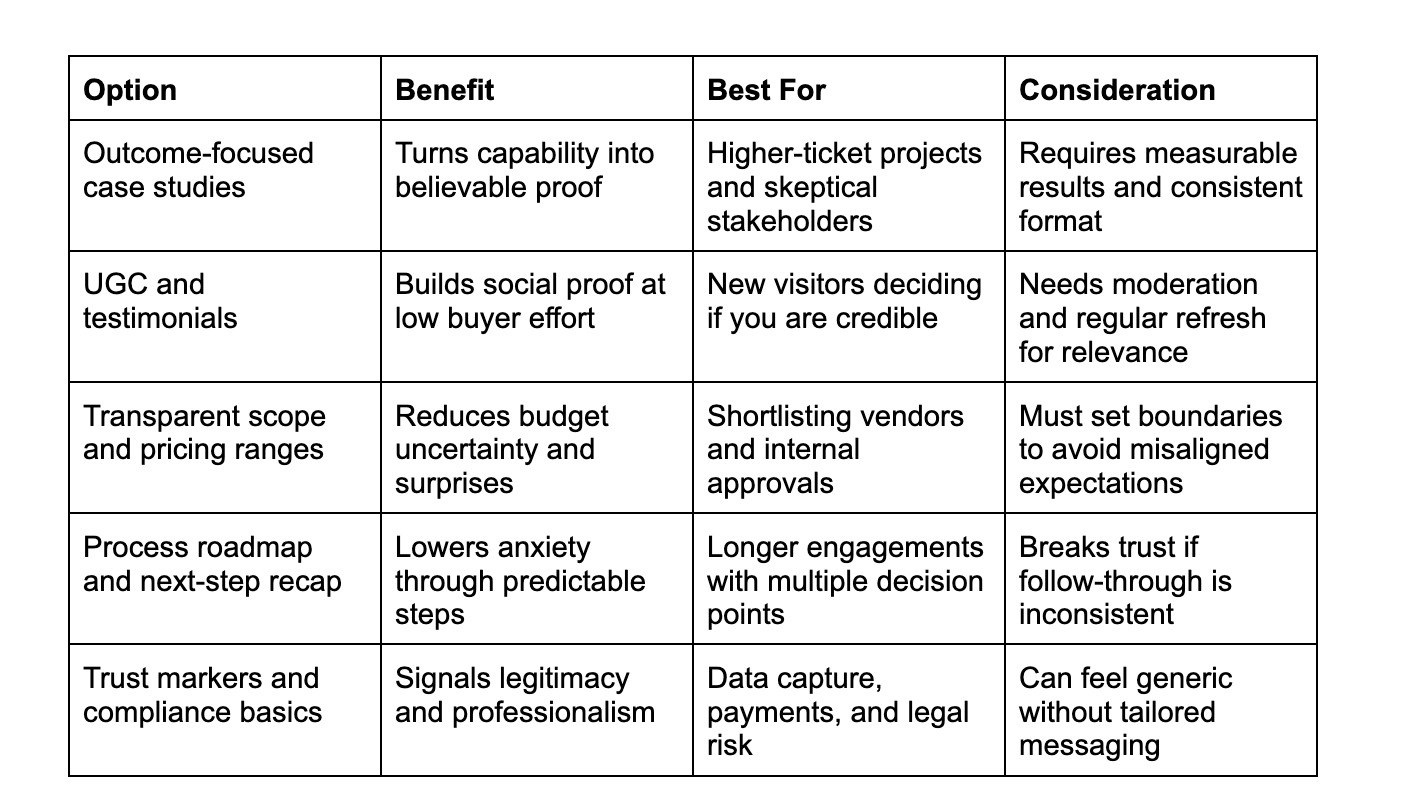
If you need quick momentum, start with social proof since the presence of UGC can support a 3.2% conversion rate in one analysis and can lift results with an additional 3.8% when visitors engage with it. Then reinforce with clarity tools like scope, roadmap, and recap so confidence compounds. Knowing which option fits best makes your next move clear.
Next, we will address the common worries that keep owners from using a calm, trust-first sales approach.
Trust-First Selling Questions Business Owners Ask
Q: How do I avoid sounding “too soft” when I stop pushing?
A: Calm does not mean passive. Lead with a clear recommendation, the reason behind it, and the tradeoffs so the buyer can decide with confidence. End every call with a recap and a specific next step with a date.
Q: What if being non-aggressive makes me lose deals to pushier competitors?
A: Some buyers will choose pressure, and that is not your best-fit work. Consultative selling is a
buyer-centric approach that helps serious clients defend their decision internally, which often beats urgency tactics over the full buying cycle. Tighten your proposal to highlight outcomes, risks, and what “done” looks like.
Q: How should I respond when a prospect says “I need to think about it”?
A: Treat it as a clarity request, not a rejection. Ask what still feels uncertain: scope, timeline, proof, or internal approval. Then offer one concrete asset like a short roadmap, a relevant case example, or a revised scope range.
Q: Why do objections show up even when my work is strong?
A: Objections are normal, and
75% of shopper calls include at least one. Prepare calm responses to the top three you hear and practice saying them out loud so you stay steady.
Q: Should I lower my price to reduce hesitation?
A: Not first. Reduce perceived risk by tightening deliverables, defining what is excluded, and offering milestone-based check-ins. If the budget is real, adjust scope before discounting so expectations stay clean.
Trust grows fastest when your clarity and follow-through feel effortless to the buyer.
Turn Customer Reassurance Into Reliable Trust-Driven Conversions
Hesitant clients rarely need more pressure, they need clarity and the feeling that saying yes is safe. A trust-first, motivating sales approach replaces chasing with customer reassurance and building reliability, so confidence grows on both sides of the conversation. When this becomes the default, sales success from trust shows up as smoother decisions, fewer last-minute stalls, and more consistent trust-driven conversions. Conversions rise when reliability makes the next step feel safe. Choose one trust-driven conversion upgrade and implement it this week, then keep it steady. That consistency is what turns today’s effort into resilient growth tomorrow.