

The Hidden Cost of Disconnected Tools in Modern Operations

Business owners and team leaders rely on software systems to keep operations running smoothly. Yet many organizations unknowingly operate on a patchwork of disconnected tools—separate platforms for monitoring, ticketing, cybersecurity, performance tracking, and reporting.
The result? Operational gaps that rarely show up in a dashboard—but surface at the worst possible moment.
When systems don’t talk to each other, blind spots form. Those blind spots impact visibility, incident response, and ultimately, decision-making.
What’s Really Happening Beneath the Surface
When teams rely on siloed systems, several patterns emerge:
- Monitoring tools detect issues, but alerts don’t reach the right teams.
- Security platforms log threats, but context isn’t shared with support.
- Performance data lives in one dashboard, operational metrics in another.
- Leadership receives incomplete reports stitched together manually.
These gaps are rarely dramatic at first. They show up as slow troubleshooting, unclear accountability, or inconsistent data between departments.
Over time, they compound.
Quick Takeaways for Leaders
If your technology stack is fragmented, you’re likely experiencing:
- Slower response times during outages
- Increased exposure to cybersecurity risks
- Duplicate work across teams
- Inconsistent performance reporting
- Poor cross-functional coordination
Integration isn’t just about convenience. It’s about operational resilience.
How Fragmented Architecture Creates Blind Spots
Disconnected tools introduce risk in four major areas:
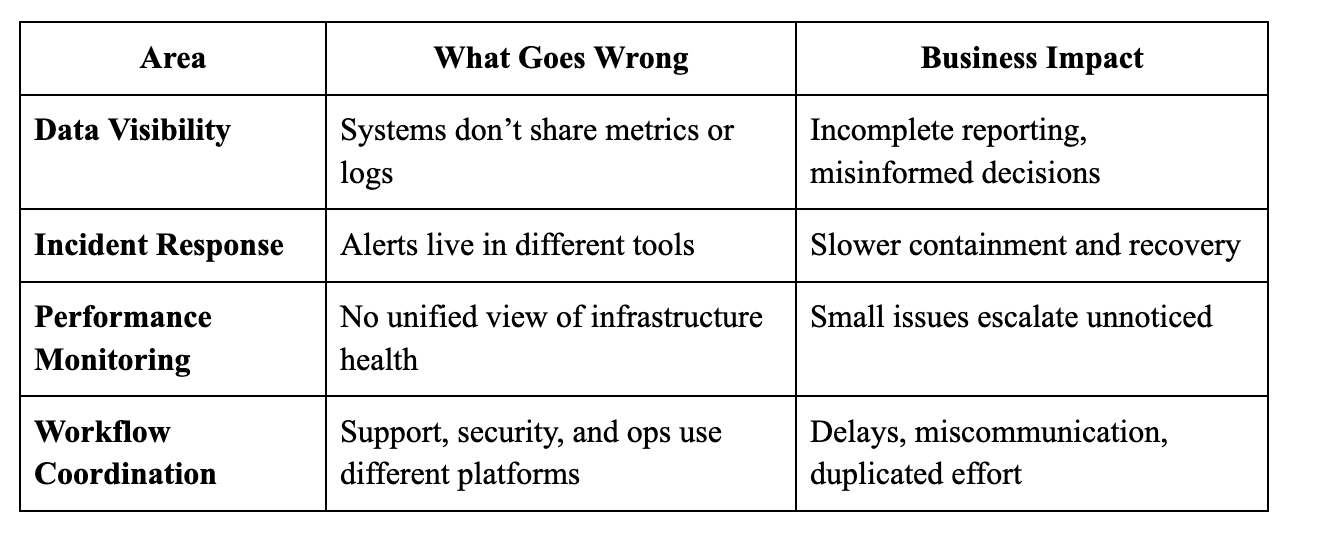
When information is scattered, context is lost. Teams may fix symptoms without understanding root causes. Leadership may see isolated metrics without recognizing systemic risk.
At scale, this erodes reliability and trust.
Where IT Monitoring Blind Spots Begin
Many IT monitoring blind spots stem from fragmented systems, limited infrastructure visibility, and weak coordination between support and security functions. A security alert might never correlate with a performance anomaly. A support ticket might reveal infrastructure strain that monitoring dashboards don’t clearly surface.
When technology environments are uni fied, teams gain a shared operational picture.
Businesses working with Olive Street Design’s IT infrastructure and support solutions—delivered in partnership with TechVoo—benefit from a consolidated approach that brings network setup, cybersecurity management, system support, and infrastructure optimization under one coordinated strategy.
By creating a well-structured, fully supported IT foundation, organizations improve visibility across tools, close monitoring gaps, and enable faster responses to both performance issues and security threats.
Closing the Gaps with Unified Monitoring
An integrated observability strategy can significantly reduce blind spots caused by disconnected systems. For example, an IT monitoring and troubleshooting platform can centralize data across infrastructure layers, allowing teams to detect anomalies, correlate events, and understand dependencies in real time.
A modern on-premises monitoring tool can unify visibility across servers, applications, and network environments. By incorporating automation, analytics, and machine learning capabilities, these platforms help identify performance trends, reduce manual intervention, and improve decision-making at scale.
When data is consolidated, teams spend less time switching dashboards and more time resolving issues.
A Practical Checklist for Improving Visibility
If you suspect fragmentation is affecting your organization, start here:
Step 1: Audit Your Tools
- List all monitoring, security, support, and reporting platforms.
- Identify overlapping functionality.
- Note where integrations are missing.
Step 2: Map Communication Gaps
- Do alerts automatically notify relevant stakeholders?
- Can support see security context?
- Can leadership view a unified operational dashboard?
Step 3: Evaluate Infrastructure Architecture
- Is your network documented?
- Are system dependencies clearly mapped?
- Is performance data centralized?
Step 4: Align Teams
- Define shared incident response protocols.
- Clarify ownership between support and security.
- Standardize reporting metrics.
Small improvements in alignment can dramatically reduce systemic risk.
The Impact on Reliability and Security
Fragmented systems weaken reliability in subtle ways.
When visibility is partial, decisions are reactive. When metrics are isolated, patterns go unnoticed. When coordination depends on manual handoffs, response times suffer.
Security is especially vulnerable in disconnected environments. Attack indicators may be detected but not contextualized. Logs may exist without correlation. Compliance gaps may remain hidden until audits.
Integration creates clarity. Clarity reduces risk.
Frequently Asked Questions
Why do disconnected tools create operational risk?
Because they prevent teams from seeing the full picture. Without shared data and integrated alerts, issues are harder to diagnose and resolve.
Can small businesses be affected by tool fragmentation?
Yes. Even small teams using separate tools for support, monitoring, and security can experience delays and blind spots if systems aren’t aligned.
Is integration only about technology?
No. It also involves process alignment. Teams need shared workflows, clear ownership, and consistent reporting standards.
How do unified systems improve decision-making?
Leaders gain consolidated dashboards, clearer performance metrics, and faster access to accurate data—supporting confident, informed decisions.
A Practical Resource to Strengthen Your Risk Strategy
Understanding and managing technology risk is essential for any organization that depends on digital systems. One resource worth exploring is the ISACA IT Risk Resources hub, which offers guidance, frameworks, and tools designed to help business leaders and IT professionals align risk practices with operational needs. This resource provides insights into comprehensive frameworks for identifying and managing IT risks, including governance, assessment methods, and practical strategies to build a more resilient technology environment.
Final Thoughts
Disconnected tools rarely fail loudly—they fail quietly, through missed signals and delayed responses.
When systems are unified and teams share visibility, organizations operate with greater confidence and resilience. Integration reduces risk, improves coordination, and strengthens decision-making at every level.