

Hidden Website Wins: Smart Ways Small Businesses Can Build a Better Site

Small business owners often hear the same recycled advice about “making a great website” — add photos, tighten your copy, be mobile-friendly. Useful, sure, but not enough. What actually moves the needle tends to be quieter, more structural choices that influence how customers experience (and trust) your brand from the moment they land on your site. Below is a collection of under-discussed, high-impact tactics to help you build a website that sells, reassures, and invites people back.
Key Takeaways
- Your website succeeds when visitors instantly know who you are, what you offer, and why you’re trustworthy.
- Small shifts in structure, formatting, and clarity often outperform large design overhauls.
- Treat your site like a living storefront: update it, tighten it, re-validate it regularly.
Why Small Tweaks Have Outsized Effects on Your Website
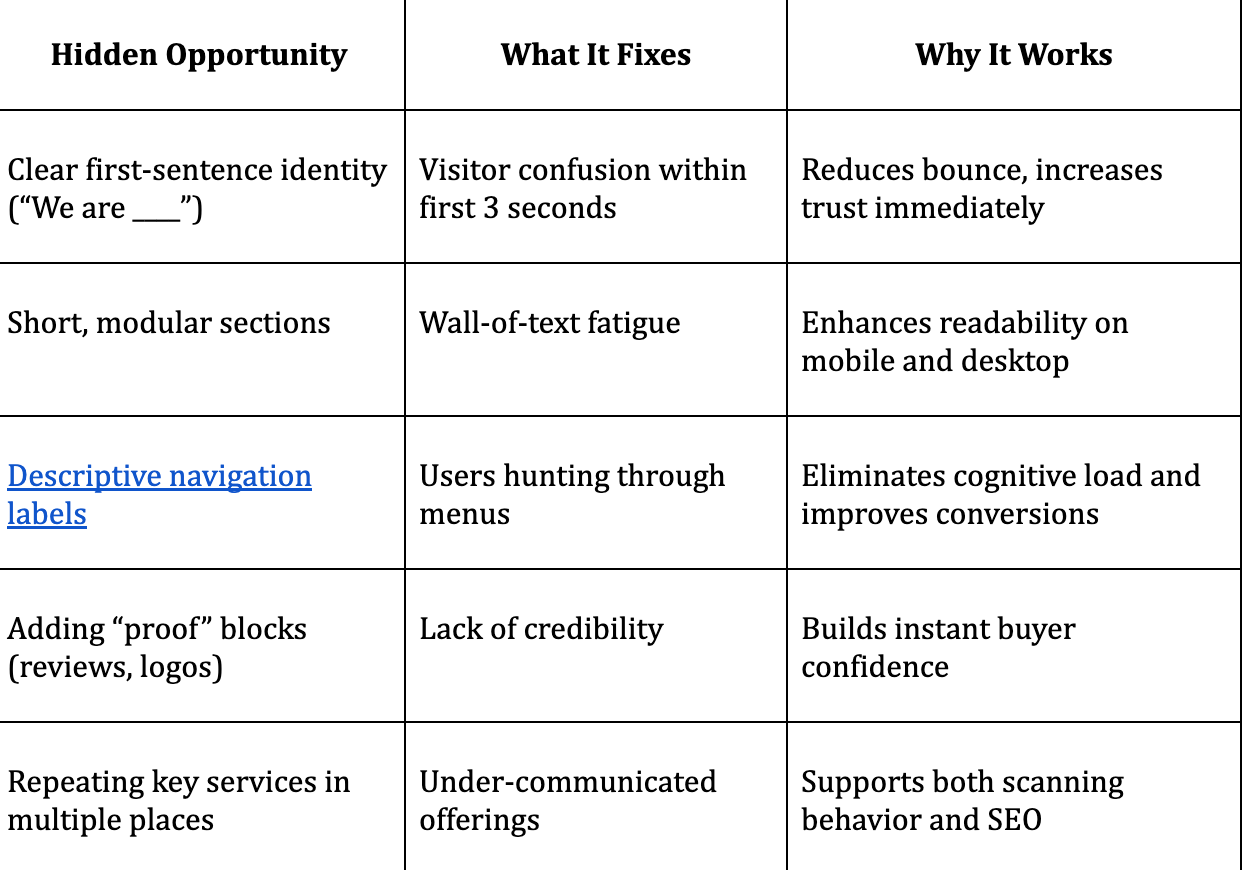
Most small business sites fail not because they’re ugly — but because they create micro-friction. Hidden navigation paths, vague headlines, scattered content, or missing reassurance signals quietly push visitors away. When your structure is intuitive and your site “makes sense” at a glance, two things happen: visitors stay longer, and search engines understand you better. Both outcomes reinforce visibility and conversions.
Small Improvements with Positive Outcomes
Your Small Business Website Audit: What to Fix First
Use this to self-audit your website in 10 minutes:
- Does the homepage state your business name and purpose within the first line?
- Are your services described in short, scannable sections?
- Is every page reachable in two clicks or fewer?
- Do your images have
descriptive alt text?
- Is your contact info visible without scrolling?
- Does your site contain at least one social proof element per major page?
- Do you explain what makes you different in concrete terms?
- Is your footer complete with address, links, and reassurance elements?
- Have you eliminated vague labels like “Solutions” in favor of “Services” or “Pricing”?
- Does each page end with a clear next step?
When Expert Help Makes the Difference
Even the most resourceful business owners sometimes hit a ceiling when building or refining their site. This is where partnering with professionals can create outsized results. A team like Olive Street Design can bring clarity, custom creative direction, and strategic branding that goes far beyond what DIY tools provide. When experts shape the structure, visuals, and messaging, your website becomes more than a digital brochure — it turns into an engine that attracts, guides, and converts customers.
Boosting Your Capabilities Through Formal Learning
Some entrepreneurs prefer taking the long-term route and expanding their own technical skills. Earning a bachelor of computer science can strengthen your understanding of how websites really function and what makes them secure, scalable, and easy to maintain. This type of degree deepens your knowledge of coding, site architecture, cybersecurity, and even fundamentals tied to modern automation and AI. And because you can complete the program online, it’s easier to balance your coursework with the ongoing demands of running your business.
High-Impact Website Moves Most Small Businesses Miss
Here are a few lesser-known yet consistently effective techniques:
- Name your pages with intent. Title tags like “Local Landscaping Services — Springfield” help humans and search engines alike.
- Use repeating micro-headlines. Visitors skim. Reinforcing your main value in multiple places helps them form a clear story.
- Bundle related services in short clusters. This creates clarity, reduces overwhelm, and nudges people toward the right choice.
- Introduce “why it matters” explanations. Don’t just list features — explain impact in one sentence.
- Add a subtle welcome message. Simple warmth increases time on page and makes your brand feel human.
Creating an Effective Homepage
- Start with identity: One sentence stating
who you are and what you offer.
- Follow with proof: Ratings, testimonials, recognizable partners, or years in business.
- Present your primary services: Clear, concise blocks with obvious next steps.
- Add reassurance: Guarantees, FAQs, or simple explanations of how your process works.
- Close with a call to action: A button or link that
stands out and guides the visitor.
FAQs
Q: What’s the biggest mistake small business owners make with their website?
A: Burying essential information. If a visitor has to hunt for what you sell, they won’t stay long enough to buy.
Q: Do I need a redesign or just refinements?
A: In many cases, minor structural fixes outperform full redesigns. Start small and improve what you already have.
Q: How often should I update my website?
A: Quarterly is a healthy rhythm —
refresh copy, update images, and review calls to action.
Final Thoughts
Your website is one of the few business assets that works for you 24/7, so the small details matter. Most improvements don’t require a massive investment — just clear communication, thoughtful structure, and the right partners or learning pathways when you need them. Start with clarity, build with intention, and refine as you grow.