
Why does Chat GPT recommend some businesses and not others?
Try this. Open ChatGPT and ask: “What are the best [your type of business] companies in [your city]?”
Look at the answer. Then change the question slightly.
- “Who would you recommend?”
- “What's the best option for a small business?”
- “Which company has the strongest reputation?”
- “Who specializes in [specific service]?”
You may get different answers. That's your first lesson in AI visibility: There isn't one permanent list of businesses ChatGPT recommends.
AI recommendations aren't Google rankings
We're used to thinking about visibility as a position. You're number one. You're number four. You're on page two. AI answers don't fit neatly into that model. The platform may interpret the user's question, search current web sources when appropriate, synthesize information and produce an answer tailored to the request.
OpenAI explains that ChatGPT can search the web and provide timely answers with links to relevant sources. Public websites that allow OAI-SearchBot can be surfaced in ChatGPT search results.
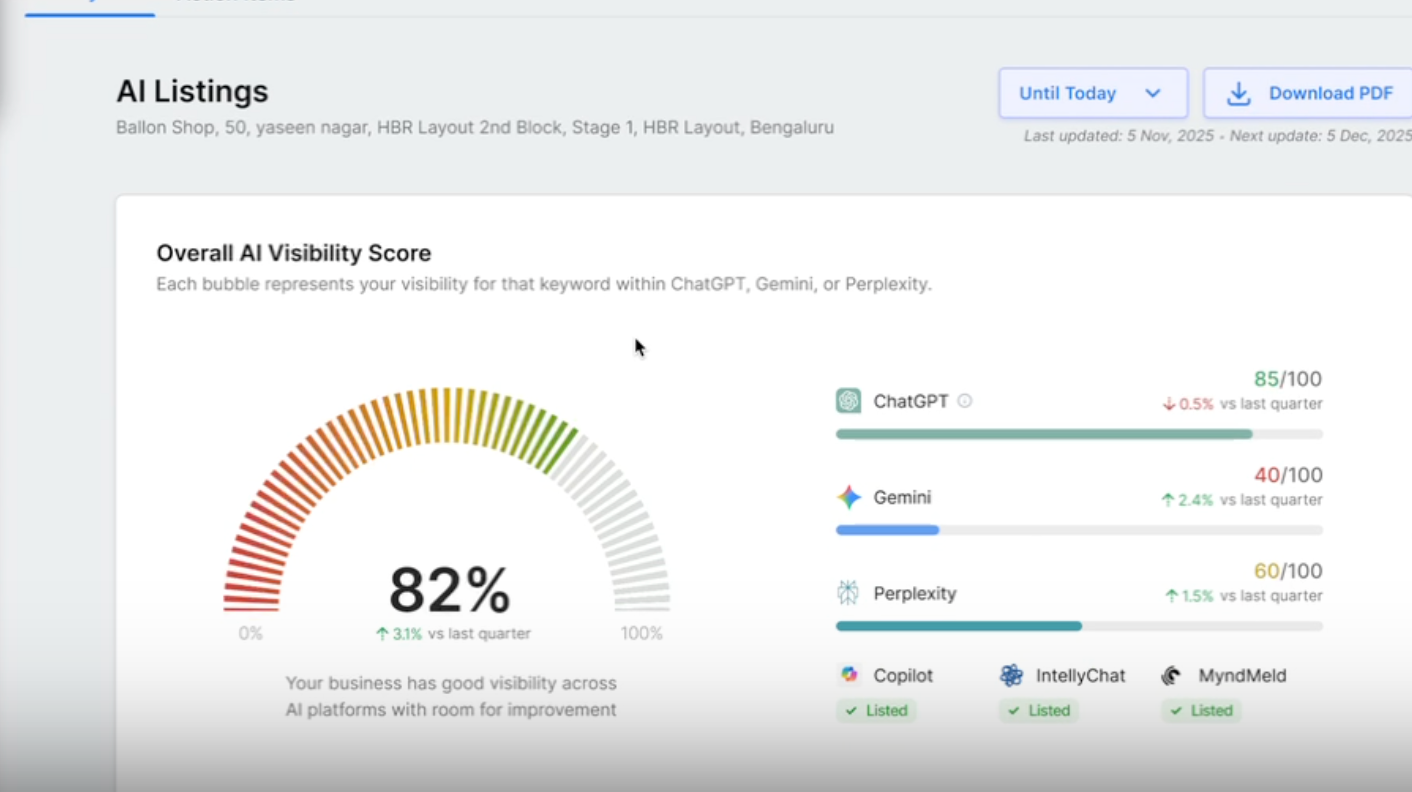
So the question becomes less: “What is my ChatGPT ranking?” and more: “For which questions is my company visible?” That's a much more useful way to think about it.
Specificity changes everything
Imagine two searches. “Best accountant in Chicago” and: “Accountant near Oak Brook who works with family-owned construction companies and can help with succession planning”
The second question contains significantly more context. That's one of the fundamental differences between conversational AI and traditional keyword searches. People can explain what they're looking for in normal language. This means businesses need to clearly communicate their specialties.
If your website simply says: “We provide exceptional solutions customized to your needs.” What exactly should an AI system — or a human being, for that matter — learn from that?
Compare it with: “We provide outsourced accounting and CFO services for family-owned construction companies with $5 million to $50 million in annual revenue.” Now we know something. Clarity matters.
Your website needs to be accessible
Before worrying about clever AI-search tactics, make sure the basic technical foundation works. OpenAI says sites that opt out of OAI-SearchBot won't be shown in ChatGPT search results. Google similarly recommends ensuring that websites can be crawled, indexed and technically understood as part of its generative AI search guidance. That's not glamorous. But neither was making sure Google could crawl your website 15 years ago. Technical fundamentals matter.
Then give the internet something useful to understand
Your website should clearly communicate:
- What you do.
- Who it's for.
- Where you work.
- What you specialize in.
- What problems you solve.
- What experience you have.
- How your process works.
- What your customers ask.
- What makes you meaningfully different.
The goal isn't to repeat a target phrase 17 times. It's to leave as little ambiguity as possible about your business.
Your broader reputation matters
Your own website will naturally portray your business positively. That's why the rest of your digital footprint is important.
- What do customers say?
- Are your business listings accurate?
- Have reputable organizations mentioned you?
- Do you belong to relevant associations?
- Do other websites describe your expertise consistently?
Google specifically notes that its generative experiences can reflect content about businesses and products found elsewhere on the web, while cautioning businesses not to manufacture inauthentic mentions simply to manipulate visibility. In other words: Build a real reputation. Don't manufacture one for a bot.
Test it — but don't obsess over one answer
Go ahead and ask ChatGPT about your company. It's useful. It's interesting. And sometimes it's humbling. Just remember that one query isn't a visibility report. Results can vary based on the question, platform and information available. The better approach is to identify the searches that matter to your customers and monitor patterns across them.
- Are you consistently absent?
- Does one competitor dominate?
- Are you associated with your most important service?
- Has visibility improved after you've strengthened your content?
Those are questions we can actually work with. AI search is still evolving. Our job isn't to find a trick that makes ChatGPT say your name tomorrow. It's to make your business increasingly clear, credible and useful everywhere customers — and the technology helping them — go looking for answers.