Olive Street Design Launches a New Website for My Zerona DuPage

Olive Street Design • August 18, 2015

Olive Street Design is excited to launch a new website for My Zerona DuPage.  Headed up by our good friend, Dr. Jawad, My Zerona DuPage offers Zerona, which is a non-invasive option that eliminates unwanted fat in the arms, hips, thighs, and waist. This safe treatment works by using a cold low-level laser device and it disrupts the fat cell membranes, which makes them collapse.  Zerona is an FDA-approved body contouring treatment that leaves patients satisfied and confident without any cumbersome surgical side effects.

This pain-free, simple treatment leaves patients inches smaller and feeling healthier and confident.  Thousands of patients have lost weight by using this cold laser technology.  They offer a free consultation, during which the doctor will evaluate if Zerona is right for you.  If you are looking to blast your trouble zones with a safe and effective treatment, call them today to schedule your free consultation.

By Lindsay Rosasco August 10, 2026
Think about the way you used to research a company online. You needed something. You Googled it. You opened several websites. You read about each company. You compared. You chose. The website did most of the educating. Now imagine a different customer journey. Someone asks: “What's the best type of flooring for a basement that has flooded before?” Then: “Which installers near me specialize in it?” Then: “What should I expect to pay?” Then: “What questions should I ask before hiring someone?” Then: “Compare these three companies.” Only after all of that does the person visit a company's website. They've never met you. But they may already know quite a bit about you. The research phase is moving This is one of the most significant changes AI could bring to digital marketing. The customer's research doesn't necessarily start on your website anymore. It may start — and continue for quite a while — inside an answer engine. ChatGPT Search can bring current web information into conversational answers with source links. Google says its AI Overviews help people understand complicated questions quickly and give them starting points for further exploration. That means discovery, education and comparison can increasingly happen before the click. And we're already seeing signs of a broader shift toward zero-click behavior. Similarweb data analyzed by SparkToro found that 68.01% of U.S. Google searches ended without any click during the first four months of 2026. People are getting more information without visiting websites. So does that make websites less important? We think the opposite may be true. Your website may receive a more informed visitor Semrush's research estimated that AI-search visitors were 4.4 times as valuable by conversion rate as traditional organic-search visitors. Again, that's an industry-wide research finding, not a promise that every website will see the same result. But consider why it might happen. A visitor who has spent ten minutes questioning an AI assistant may have already: Defined the problem. Learned the terminology. Compared approaches. Established a budget range. Identified several potential companies. Ruled some options out. Now they click. That isn't casual traffic. That's a person arriving with context. Your website has a new job Traditionally, website homepages often tried to answer: “Who are we?” That's still important. But an AI-informed visitor may arrive asking: “Are you really the company I think you are?” Your website has to confirm the recommendation. Is the company professional? Do they seem credible? Do they really specialize in what I need? Do I like their work? Do they work with people like me? Can I see examples? What do customers say? What happens next? That's why AI search does not eliminate the need for great websites. It raises the standard. Clarity beats cleverness This shift also puts pressure on vague website copy. “We provide innovative solutions designed around your needs.” What does that mean? Who do you serve? What do you actually do? Why are you different? Both humans and machines benefit from specificity. A strong modern website should make important facts easy to understand. Services. Industries. Locations. Expertise. Process. People. Proof. Frequently asked questions. Google's own generative-search guidance continues to recommend unique, valuable content and solid technical SEO as the foundation for visibility in AI-powered Google experiences. There isn't a conflict between building for humans and building for search. The best sites increasingly need to do both exceptionally well. Your expertise needs to exist somewhere There's another interesting consequence. AI can't surface expertise you've never shared. If your sales team answers an important customer question every day but your website says nothing about it, that knowledge is effectively hidden. If you've solved a particular problem 200 times but have no case study, article or service content explaining that expertise, the digital world has less evidence of it. That's why content strategy matters. Not content for content's sake. Document what your business actually knows. Explain what customers need help understanding. Publish examples. Answer specific questions. Give your expertise a digital footprint. The website isn't disappearing. The journey is changing. We've built websites for a long time. We've also watched digital marketing reinvent itself repeatedly. New platforms arrive. Algorithms change. Search behavior evolves. Technology becomes more sophisticated. But the objective has stayed remarkably consistent: Help people find you, understand you, trust you and take the next step. AI doesn't change that. It changes some of the steps that happen along the way. And that's exactly why we're paying attention. At Olive Street Design, we're not interested in adding “AI” to everything because it's fashionable. We're interested in understanding where customer behavior is actually changing — and making sure the websites and marketing systems we build are ready for it. Technology will keep changing. Good communication still wins.
By Lindsay Rosasco August 10, 2026
SEO is dead. Again. If you've worked in digital marketing for any amount of time, you've heard this before. Social media was going to kill search. Voice assistants were going to kill search. TikTok was going to kill Google. Now artificial intelligence is supposedly going to finish the job. Meanwhile, people are still searching. What's actually changing is where and how they search. And that's where AEO enters the conversation. First: what is SEO? SEO stands for Search Engine Optimization. At its simplest, SEO is the work of helping search engines understand your website and helping the right people discover it when they search. That includes things like: Website structure Technical performance Keyword and audience research Useful content Local search optimization Google Business Profiles Links and authority Structured data Page titles and metadata User experience SEO has never really been about stuffing magic words into a page. Good SEO is largely about making your website useful, understandable and technically accessible. What is AEO? AEO stands for Answer Engine Optimization. The term is generally used to describe efforts to improve a brand's visibility in systems that answer questions directly rather than simply returning a traditional list of links. Think: ChatGPT. Google AI Overviews and AI Mode. Gemini. Perplexity. And other AI-assisted search experiences. Instead of trying only to earn a high-ranking link, businesses are also becoming interested in whether their information gets cited, summarized or incorporated into an AI-generated answer. Hence the phrase we've been using frequently at OSD: Don't just rank. Be part of the answer. So is AEO replacing SEO? No. In fact, Google itself currently takes an even stronger position. Google says that, from its perspective, optimizing for generative AI search is still SEO because AI Overviews and AI Mode are rooted in Google's existing search ranking and quality systems. Its guidance specifically says foundational SEO practices continue to matter for generative AI visibility. That's important because the AI-search boom has inevitably created a new industry of hacks. Special files. Secret formatting. Guaranteed ChatGPT rankings. Magic schemas. Guaranteed mentions. Be careful. Google specifically says businesses do not need special AI text files such as llms.txt to appear in Google's generative search features, and warns against chasing inauthentic mentions. There is no single button labeled “optimize for every AI.” What overlaps? A lot. Imagine a useful service page that: clearly explains what you offer, answers customer questions, shows relevant expertise, loads properly, can be crawled, contains accurate information, and connects logically to the rest of your website. That's a good SEO page. It's also the type of clear, useful information AI-powered search systems can work with. Google's current generative-search guidance recommends unique, valuable content, strong technical structure and established SEO fundamentals. So businesses shouldn't throw away the SEO playbook. They should expand it. Where does AI search introduce something new? Measurement is one big difference. Traditional SEO has familiar metrics: Rankings. Organic traffic. Clicks. Impressions. Conversions. AI visibility introduces additional questions: Was our company mentioned? Were we cited? Which prompts triggered us? Which competitors appeared? How were we described? Which topics are we associated with? That requires a different lens. And because AI answers can vary by prompt and platform, simply asking ChatGPT one question isn't the equivalent of checking a Google ranking. What about ChatGPT specifically? ChatGPT Search can retrieve current web information and link to relevant web sources. OpenAI uses OAI-SearchBot for search visibility and states that websites blocking that crawler won't be surfaced in ChatGPT's search results. So technical accessibility matters there, too. Again, not exactly a revolutionary concept. If you want search technology to use your website, make sure the search technology can access your website. What should businesses do right now? Don't panic. Don't cancel your SEO. Don't publish 400 AI-generated FAQ pages. Don't buy every new service with “GEO” in its name. Instead : 1. Keep strengthening your SEO foundation. 2. Make your services exceptionally clear. 3. Answer the questions customers actually ask. 4. Publish original expertise rather than commodity content. 5. Keep reviews, listings and business information accurate. 6. Make sure search and AI crawlers can access appropriate public content. 7. Start monitoring AI visibility alongside traditional search performance. That's a sensible strategy regardless of which acronym ultimately survives. SEO isn't dead. Search simply has more places to happen now.
By Lindsay Rosasco August 10, 2026
Try this. Open ChatGPT and ask: “What are the best [your type of business] companies in [your city]?” Look at the answer. Then change the question slightly.  “Who would you recommend?” “What's the best option for a small business?” “Which company has the strongest reputation?” “Who specializes in [specific service]?” You may get different answers. That's your first lesson in AI visibility: There isn't one permanent list of businesses ChatGPT recommends. AI recommendations aren't Google rankings We're used to thinking about visibility as a position. You're number one. You're number four. You're on page two. AI answers don't fit neatly into that model. The platform may interpret the user's question, search current web sources when appropriate, synthesize information and produce an answer tailored to the request. OpenAI explains that ChatGPT can search the web and provide timely answers with links to relevant sources. Public websites that allow OAI-SearchBot can be surfaced in ChatGPT search results. So the question becomes less: “What is my ChatGPT ranking?” and more: “For which questions is my company visible?” That's a much more useful way to think about it. Specificity changes everything Imagine two searches. “Best accountant in Chicago” and: “Accountant near Oak Brook who works with family-owned construction companies and can help with succession planning” The second question contains significantly more context. That's one of the fundamental differences between conversational AI and traditional keyword searches. People can explain what they're looking for in normal language. This means businesses need to clearly communicate their specialties. If your website simply says: “We provide exceptional solutions customized to your needs.” What exactly should an AI system — or a human being, for that matter — learn from that? Compare it with: “We provide outsourced accounting and CFO services for family-owned construction companies with $5 million to $50 million in annual revenue.” Now we know something. Clarity matters. Your website needs to be accessible Before worrying about clever AI-search tactics, make sure the basic technical foundation works. OpenAI says sites that opt out of OAI-SearchBot won't be shown in ChatGPT search results. Google similarly recommends ensuring that websites can be crawled, indexed and technically understood as part of its generative AI search guidance. That's not glamorous. But neither was making sure Google could crawl your website 15 years ago. Technical fundamentals matter. Then give the internet something useful to understand Your website should clearly communicate: What you do. Who it's for. Where you work. What you specialize in. What problems you solve. What experience you have. How your process works. What your customers ask. What makes you meaningfully different. The goal isn't to repeat a target phrase 17 times. It's to leave as little ambiguity as possible about your business. Your broader reputation matters Your own website will naturally portray your business positively. That's why the rest of your digital footprint is important. What do customers say? Are your business listings accurate? Have reputable organizations mentioned you? Do you belong to relevant associations? Do other websites describe your expertise consistently? Google specifically notes that its generative experiences can reflect content about businesses and products found elsewhere on the web, while cautioning businesses not to manufacture inauthentic mentions simply to manipulate visibility. In other words: Build a real reputation. Don't manufacture one for a bot. Test it — but don't obsess over one answer Go ahead and ask ChatGPT about your company. It's useful. It's interesting. And sometimes it's humbling. Just remember that one query isn't a visibility report. Results can vary based on the question, platform and information available. The better approach is to identify the searches that matter to your customers and monitor patterns across them. Are you consistently absent? Does one competitor dominate? Are you associated with your most important service? Has visibility improved after you've strengthened your content? Those are questions we can actually work with. AI search is still evolving. Our job isn't to find a trick that makes ChatGPT say your name tomorrow. It's to make your business increasingly clear, credible and useful everywhere customers — and the technology helping them — go looking for answers.
By Lindsay Rosasco August 10, 2026
AI has made it possible to create a 1,000-word blog post in about 30 seconds. That's impressive. It's also creating a lot of really bad content. Search almost any business topic today and you'll find articles that technically contain all the right words but say remarkably little. “Five reasons marketing is important.” “Ten benefits of hiring a professional.” “The ultimate guide to choosing the right company.” You've read them. Or perhaps you've opened them, skimmed two paragraphs and immediately left. The problem isn't that AI helped create them. The problem is that nobody added anything worth knowing. More content isn't automatically better For years, businesses heard some version of: “You need to blog for SEO.” So they blogged. Sometimes thoughtfully. Sometimes because the marketing calendar said Thursday needed a post. Generative AI has taken that temptation to another level. Why publish four articles a month when you could publish forty? Because forty mediocre articles don't necessarily help anyone. Google's current guidance actually addresses this directly. It says generative AI can be useful for research and for adding structure to original content, but generating many pages without adding value can violate its spam policies on scaled content abuse. Google's newer generative-search guidance goes even further, recommending unique, expert-led, non-commodity content that provides value beyond common knowledge. We like that phrase: Beyond common knowledge. That's the opportunity. What do you know that the internet doesn't? Every good business accumulates knowledge. A roofer knows which problems homeowners routinely misdiagnose. A dentist knows what nervous patients ask before their first appointment. A restaurant knows which menu item people discover and then order every week. A financial professional knows which questions clients are embarrassed to ask. A manufacturer knows which “simple” purchasing mistake creates expensive problems later. A remodeling company knows which Pinterest ideas look great but don't work in an actual 1920s Chicago bungalow. That's content. Not because a keyword tool told you to write it. Because your customers actually need the answer. Start with the questions your team hears If you want better website content, ask the people answering your phone. Ask your sales team. Ask customer service. Ask the owner. What did customers ask this week? Write those questions down. Now answer them thoroughly. Not with a 75-word FAQ written to squeeze a keyword onto the page. Give the answer you'd give a good customer sitting across the table. Explain the nuance. Talk about when the answer changes. Give examples. Mention common mistakes. Say what you actually think. That's useful content. FAQs are more valuable when they're real FAQ sections are everywhere now. Unfortunately, many of them are written backward. Instead of collecting questions customers actually ask, someone decides which keywords the company wants to rank for and turns them into fake questions. People can tell. Better: “How long will I be without my kitchen during a remodel?” Worse: “Why is ABC Remodeling the best kitchen remodeling contractor in Chicago?” One is a customer's question. The other is an advertisement wearing a question mark. Answer real questions. AI can still help None of this means we're anti-AI. Far from it. AI is a fantastic tool. It can help organize ideas. Find gaps. Turn notes into an outline. Repurpose a useful article. Suggest questions you haven't considered. Improve readability. But there's an enormous difference between: using AI to help communicate your expertise and asking AI to invent expertise for you. At Olive Street Design, we believe the first is where things get interesting. Technology should support the human knowledge inside your business, not flatten it into the same article everyone else publishes. What should businesses create? Start with content that answers high-intent, specific questions. Think : Frequently asked questions Detailed service pages Pricing explanations Process guides Case studies Before-and-after stories Comparisons Common mistakes Industry-specific advice Local expertise Original research or observations Questions customers should ask before hiring someone You don't need to create everything at once. One genuinely useful page is worth more to your customer than a folder full of filler. Become worth citing Search is changing. AI tools increasingly synthesize information rather than simply handing users a list of links. But the basic challenge for businesses hasn't really changed: Say something worth finding. If every sentence on your website could appear on any competitor's site simply by changing the company name, you have a content problem. AI can help you write faster. Your experience is what gives the writing a reason to exist.
By Lindsay Rosasco August 10, 2026
Here's a useful exercise. Search your business online — but don't look only at your website. Look at everything around it. Your Google Business Profile. Reviews. Business directories. Articles. Social profiles. Industry associations. Old addresses. Old phone numbers. Awards. Interviews. Mentions on other websites. Now ask yourself: If you knew nothing about this company, what would all of this information lead you to believe? That's your digital reputation. And as AI becomes part of how people research businesses, that broader picture matters even more. AI isn't learning about your company from one page It's tempting to imagine AI search like traditional SEO: We optimize a page. The page ranks. Done. But AI-powered search experiences can synthesize information from multiple sources. Google says its generative search experiences can surface what is being said about products and services across the web, including information from blogs, videos and forum discussions. It also notes that Google Business Profiles can help local business information remain visible in both AI responses and other Google Search experiences. ChatGPT Search similarly provides web-backed answers with links to sources when web search is used. That means your website is extremely important. It just isn't the only piece of information in the room. Think of trust as consistency Let's say your website says you serve Chicago and the western suburbs. One directory lists only Chicago. Another has an address from six years ago. Your Google Business Profile has the correct address but outdated services. A third-party article describes your company differently. Your website barely explains what makes you different. Then someone — human or AI — tries to understand your business. You've made the job unnecessarily difficult. Strong digital brands tell a consistent story. Who are you? What do you do? Where do you do it? Who do you serve? Why should anyone trust you? Those answers should become clearer the more someone researches you, not more confusing. Reviews are for humans first Whenever we talk about AI visibility, it's important not to turn normal marketing into strange attempts to manipulate algorithms. You should not pursue fake reviews, artificial mentions or low-quality placements because someone claims they'll “train ChatGPT” to recommend you. Google explicitly cautions against seeking inauthentic mentions as an AI-search tactic. Its search systems continue to emphasize quality and spam prevention. Build reputation because reputation matters to customers. Ask real clients for real reviews. Keep your business listings accurate. Earn legitimate mentions. Join relevant associations. Share useful expertise. Publish examples of your work. Show the people behind the company. Those things were smart marketing before ChatGPT existed. They're smart marketing now. Your website needs trust signals, too Take another look at your own site. Can someone easily find: Real customer testimonials? Examples of completed work? Team members and their experience? Industry credentials? Awards or affiliations? Detailed service information? Answers to common questions? A real phone number and contact information? Information about the areas you serve? Trust isn't created by writing “We're a trusted leader” in giant letters. It comes from evidence. AI visibility gives businesses another reason to clean house This is one reason we're excited about AI visibility at OSD. It's not simply another score. It encourages businesses to examine their entire digital footprint. Maybe AI doesn't understand one of your services because your website barely talks about it. Maybe a competitor has ten useful articles answering customer questions and you have none. Maybe your Google Business Profile still reflects how the company looked three years ago. Maybe you have dozens of happy customers but almost no reviews. Those aren't just AI problems. They're marketing problems. AI is simply giving us another way to see them. Start with the basics There will be plenty of new terminology surrounding AI search. AEO. GEO. LLM optimization. AI visibility. Some of it is useful. Some of it is marketing. Our advice is simpler. Build a business online that is easy to understand and easy to trust. Create a strong website. Publish useful information. Keep your business details accurate. Earn authentic reviews. Build a real reputation. Monitor what search engines and AI platforms are saying about you. Technology is changing quickly. Trust isn't.
By Lindsay Rosasco August 10, 2026
AI chatbot conversations have a tendency to get futuristic very quickly. Let's make this much simpler. Imagine someone visits your website tonight at 9:17. They have a question. “Do you service my town?” “Do you work with businesses my size?” “Can I schedule an appointment?” “What's included?” “Do you offer this specific service?” Your office is closed. What happens next? Traditionally, that visitor has three options: Search your website for the answer. Fill out a form and wait. Leave. An AI chatbot gives them a fourth option: Ask. A chatbot isn't there to replace your team This is one of the biggest misconceptions about adding AI to a website. The goal isn't to make your business feel like it's being operated by robots. Quite the opposite. A useful chatbot should help your website behave a little more like a helpful employee. It can answer straightforward questions when your team isn't available, direct visitors toward relevant information and make it easier for someone to take the next step. Then, when a conversation actually requires a human, your team takes over. That's the sweet spot. What can a website chatbot answer? The best use cases are usually the least glamorous ones. Questions customers ask every day. For example: A restaurant: “Do you have gluten-free options?” A home service company: “Do you service Naperville?” A dental practice: “Are you accepting new patients?” A law firm: “Do you handle this type of case?” A professional services company: “How do I get a quote?” These may seem like small questions. But small questions can stand between a website visitor and an inquiry. If someone can't quickly figure out whether you solve their problem, they're unlikely to spend ten minutes digging through your site. It can also help people navigate Modern websites often contain a lot of information. Services. Locations. FAQs. About pages. Blog articles. Forms. Scheduling pages. A chatbot can help a visitor navigate all of that through conversation. Instead of searching menus, someone can simply ask: “Where can I see examples of your work?” or: “I need help with X. Which service should I look at?” That's a fundamentally different experience from traditional website navigation. And yes, it can capture leads Sometimes the question isn't the end goal. The visitor is ready to talk. A chatbot can help move that person toward the appropriate contact or lead-capture process rather than leaving them to hunt for a button. This is especially useful outside normal business hours. Your company doesn't need to have someone monitoring the website at 11 p.m. for the website to remain useful at 11 p.m. What shouldn't a chatbot do? This part matters. A chatbot shouldn't pretend to know things it doesn't. It shouldn't provide made-up pricing, policies or promises. It shouldn't create friction when someone simply wants to talk to a person. And it shouldn't feel like a pop-up obstacle preventing visitors from using the website normally. AI should make the experience easier. Not more annoying. That's the standard we use when evaluating any new website technology at Olive Street Design. Does this actually make the customer's experience better? If the answer is no, adding “AI” to the product name doesn't change our opinion. Try one instead of imagining it Sometimes the easiest way to understand a chatbot is just to use one. Visit Olive Street Design's website and ask ours a question. Ask something simple. Ask something specific. Try asking about a service. See what happens. That's more useful than another paragraph about artificial intelligence. For existing OSD clients, we've made the chatbot available for $29/month, with the first month free. Not because every business suddenly needs another piece of technology. But because your website is working even when you aren't. We think it should be able to answer a question then, too.
By Lindsay Rosasco August 10, 2026
For years, digital marketing had a fairly simple goal: Get more people to the website. More rankings created more impressions. More impressions created more clicks. More clicks created more opportunities to turn visitors into customers. That equation isn't disappearing. But it is changing. Today, a customer can ask an AI tool a detailed question, compare options, read summaries, narrow down a shortlist and learn quite a bit about your business — all before visiting your website. That means businesses may eventually receive fewer exploratory clicks. But the clicks they do receive could be much more interesting. One statistic caught our attention Semrush studied traffic coming from AI platforms and estimated that the average AI-search visitor was 4.4 times as valuable as the average traditional organic-search visitor based on conversion rate. That's a big number. It also deserves some context. It doesn't mean every business should expect AI traffic to convert at exactly 4.4 times its Google traffic. Industries, websites, audiences, and conversion goals are different. But the reason behind the finding makes sense. Think about two visitors. The first Googles: “kitchen remodeling” They might be starting from scratch. They open five websites. They don't know what they want yet. They may simply be looking for ideas. The second asks an AI assistant: “I have a 1960s kitchen in the western suburbs of Chicago. I want to keep the footprint but replace the cabinets and countertops. What type of remodeling company should I hire, and what should I expect?” They continue asking questions. Eventually, the AI assistant mentions several companies. Then the user visits one of their websites. That second visitor has already done a lot of thinking before the click ever happens. They're further along. The disappearing click This shift isn't limited to ChatGPT. Search engines themselves are answering more questions directly. Using Similarweb clickstream data, SparkToro reported that 68.01% of U.S. Google searches ended without a click in the first four months of 2026. Some of those searches never needed a website visit in the first place. Weather, sports scores, definitions and other quick answers have produced zero-click searches for years. But AI makes it possible to answer much more complicated questions without immediately sending the user elsewhere. Google describes AI Overviews as a way for searchers to quickly understand complicated questions before exploring supporting links. The customer's research process is changing. So does website traffic no longer matter? Not at all. Traffic still matters. SEO still matters. Your website definitely still matters. But traffic volume alone tells an increasingly incomplete story. Imagine: Website A receives 1,000 visits and generates five inquiries. Website B receives 600 visits and generates twelve inquiries. Which website would you rather have? The answer is obvious. This is why businesses should increasingly look beyond raw traffic and pay attention to: Where visitors came from Which pages they viewed How long they engaged Whether they became leads Which traffic sources generate actual customers Whether AI platforms are beginning to appear in referral data OpenAI specifically notes that websites allowing OAI-SearchBot can track referral traffic from ChatGPT using analytics platforms such as Google Analytics. That's a metric we'll be watching closely. Your website's job is changing, too If an AI assistant has already told someone: what you do, where you're located, what customers say about you, how your services compare, and why you might be a good option, then your website isn't necessarily introducing your company from zero. Instead, it may be receiving someone who wants to confirm what they've already learned. Can I trust these people? Do I like their work? Do they understand my problem? What does the process look like? How do I get started? That makes strong branding, clear messaging, great design, real examples, testimonials and obvious calls to action even more important. AI can help someone discover you. Your website still has to help them choose you. Don't chase traffic. Chase the right attention. For a long time, businesses have been trained to celebrate upward-sloping traffic graphs. More is good. Less is bad. AI search may force marketers to become a little more sophisticated. Maybe the future isn't about getting every possible click. Maybe it's about being present during the research process — and earning the right click when someone is ready for you. That's a change worth paying attention to.
By Lindsay Rosasco August 10, 2026
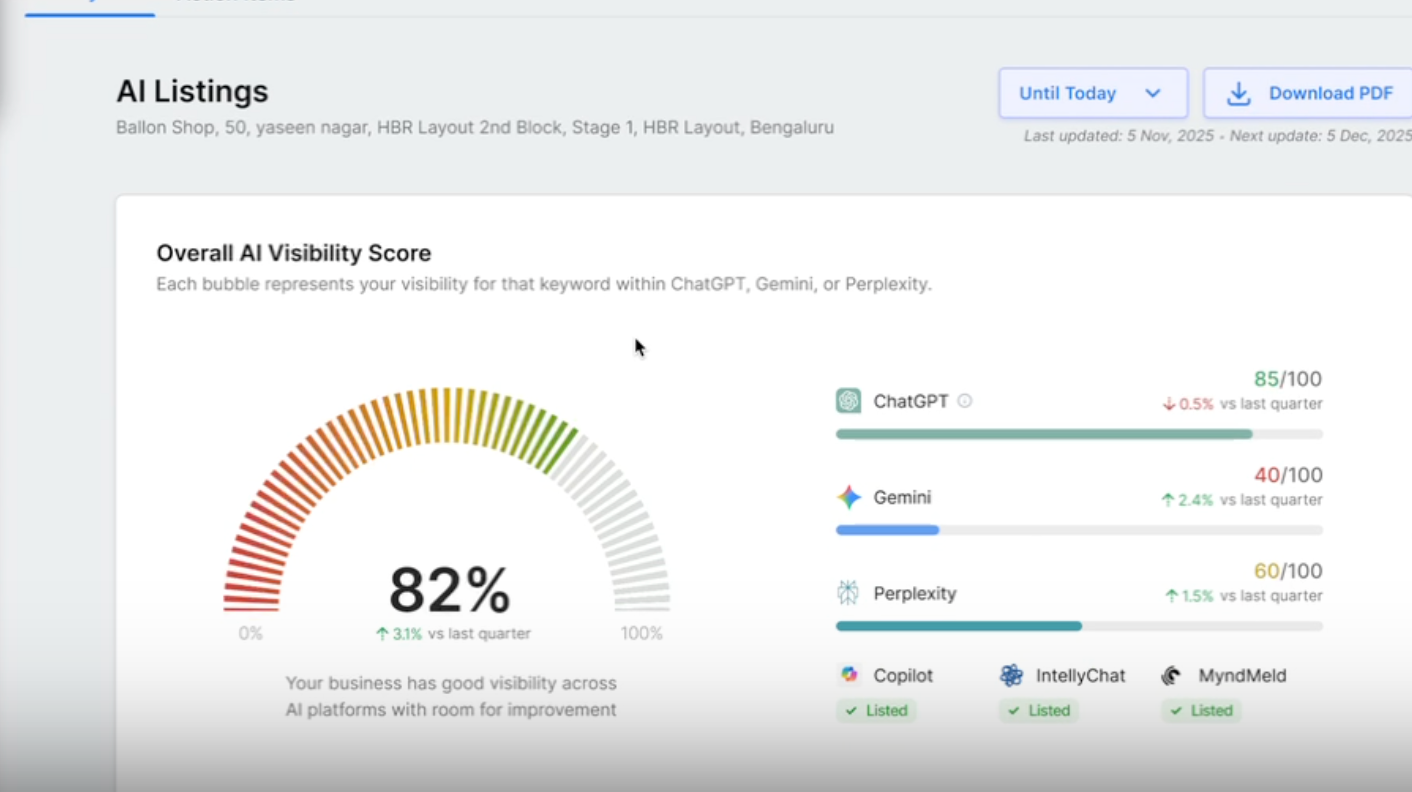
For years, businesses have paid close attention to where they rank on Google. Search your company name. Search your services. Search “best [service] near me.” See who comes up. That still matters. But there’s another question businesses should start asking: What happens when someone asks AI instead? Try asking ChatGPT, Gemini or another AI platform: “Who are the best companies for [your service] in [your city]?” Or: “Which [type of company] would you recommend?” The answer may surprise you. Your company might appear. A competitor might appear. The information about your business might be incomplete. Or you may not be mentioned at all. Welcome to AI visibility. What is AI visibility? AI visibility is a way of looking at how often and accurately your brand appears when people use AI-powered tools to research businesses, products and services. It isn't exactly the same as a Google ranking. Traditional search usually gives someone a list of results to explore. AI tools can synthesize information from multiple sources and present an answer directly to the user. ChatGPT Search, for example, can search the web and provide responses with links to web sources. OpenAI also uses a crawler called OAI-SearchBot to surface websites in ChatGPT's search features. Google is doing something similar within its own ecosystem through AI Overviews and AI Mode. So instead of only asking: “Do we rank?” Businesses increasingly need to ask: “Are we part of the answer?” Why doesn't every AI tool give the same answer? Because there isn't one universal AI search engine. Different platforms use different systems, sources and methods for generating responses. Even the wording of a question can affect what appears. You may be mentioned for one prompt and absent from another. That's why typing your company name into ChatGPT once isn't a complete AI visibility strategy. I t's a snapshot. What becomes more useful is tracking a group of relevant questions over time: Does your business appear? How frequently? Which competitors appear? What is being said about you? Which services are you associated with? Are there important topics where competitors are consistently mentioned and you aren't? Those patterns can help tell a much more useful story. Can businesses influence AI visibility? Yes — but probably not through the shortcuts you're seeing advertised online. Google's current guidance is refreshingly straightforward: its generative AI search features are built on its existing search and quality systems, and the foundational practices of SEO still apply. Google specifically recommends clear technical structure and unique, valuable, people-first content rather than chasing special “AEO” or “GEO” hacks. That means the basics matter. Your website should clearly explain: What your company does Who you serve Where you operate What makes your services different The questions your customers frequently ask The expertise and experience behind your business Your broader online presence matters, too. Google notes that its generative search features can surface information being discussed across websites, blogs, videos and forums. For local businesses, Google Business Profiles can also help business information appear across traditional and AI-powered Google experiences. In other words, your website doesn't exist in a vacuum. Visibility without context isn't enough There's another important point here. Appearing in an AI answer isn't automatically good. We also want to know how your business is being represented. Is your information correct? Does AI understand your services? Does it recognize your strengths? Is an outdated service still being associated with you? Are competitors being recommended for something you actually specialize in? Those are much better questions than simply asking whether your company was mentioned. This is still early AI search is moving quickly, and nobody can guarantee that a particular business will appear every time someone asks ChatGPT or Gemini for a recommendation. We don't think responsible agencies should promise that. What businesses can do is understand their current visibility, monitor how it changes and strengthen the digital information surrounding their brands. That's what our AI Visibility service at Olive Street Design is designed to help clients do. It gives us another lens into how your business is being discovered — alongside SEO, website analytics, reviews, listings and everything else we've spent years helping clients improve. Search isn't disappearing. It's expanding. And we think businesses should know how they look in this new part of it. Want to see what AI is saying about your business?
A man is standing at a standing desk in front of a computer.
July 16, 2026
Learn how to boost your brand with influencer marketing. Collaborate effectively for greater visibility & engagement.
July 14, 2026
The body content of your post goes here. To edit this text, click on it and delete this default text and start typing your own or paste your own from a different source.
More Posts